

Connecting on Global Integrations requires organization owner or admin. Inside a workspace, any member of that workspace can open the page, but connecting, disconnecting and changing a connection’s tools need workspace owner or admin — authority an organization owner or admin also has in any workspace they are a member of, and every organization owner and admin is added as a member when a workspace is created.
Two places to connect
The Teams app is the exception: it reads the organization’s Default workspace, not Global Integrations. See Connection scopes for the full map.
The practical consequence: connecting GitHub on Global Integrations makes it available to chat and Slack, but
receipt tools list will not show it until GitHub is also connected inside the workspace the CLI is bound to. Sign-in binds the CLI to Default; receipt workspace use moves it.
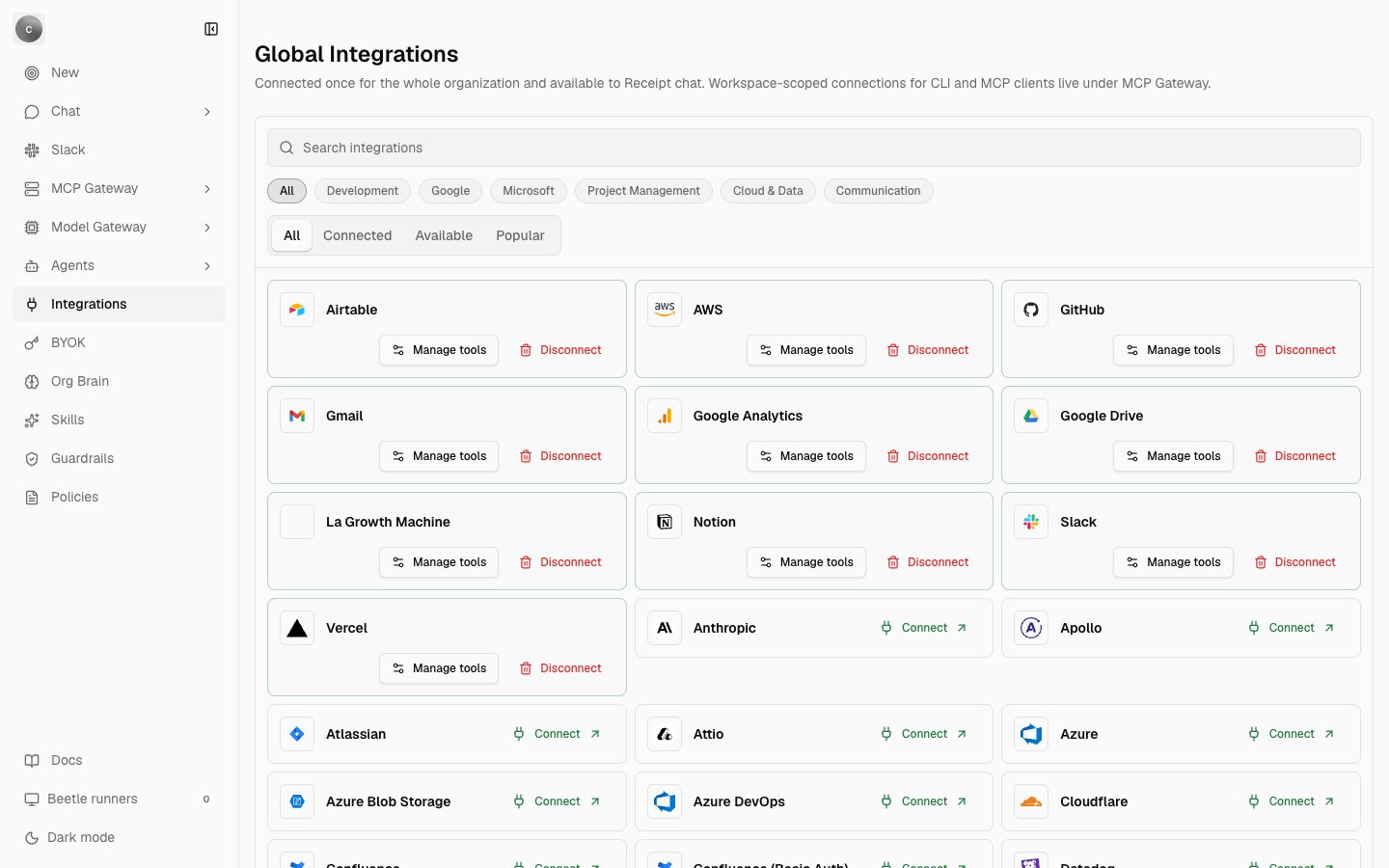
Global Integrations, reached from Integrations in the main sidebar. Search, category chips and the All / Connected / Available / Popular control sit above the cards. Connected apps such as Airtable, AWS and GitHub show Manage tools and Disconnect; apps that are not connected yet, such as Anthropic and Apollo, show Connect. The La Growth Machine card shows an empty box where its vendor logo would load; the card itself behaves like any other.
The Global Integrations page
The page is titled Global Integrations, and its own description explains the scope: connected once for the whole organization and available to Receipt chat. Workspace-scoped connections for CLI and MCP clients live under MCP Gateway instead. On the page you’ll find a Search integrations box, vendor chips for the categories in the catalog (All, Development, Google, Microsoft, Project Management, Cloud & Data, Communication), a segmented control for All, Connected, Available, and Popular, and cards loaded 60 at a time behind a Load more button that reports how many remain. Connected keeps only apps with a connection; Available keeps only apps you can connect. If nothing matches, the page says No integrations found. The catalog holds 63 connectable apps inside a browsable directory of about 900 entries. A card reads Coming soon when the app is in the directory but cannot be connected from Receipt yet. Each card tells you its state:
Manage tools opens the per-connection allowlist. Write operations are off until an owner or admin enables them per connection; there is no per-action approval prompt in this release. That dialog has its own page: Tools and permissions.
Connecting
1
Click Connect on the card
The button reads Opening while Receipt asks the integration provider for an authorization session, then a dialog titled
Connect <name> appears. Its description names the boundary you are about to cross, and it depends on where you started: at the organization level it connects the app “to this organization’s Global Integrations. Other organizations you belong to are not affected.”; from a workspace it connects the app “only to the <workspace> workspace.”2
Authorize with the provider
The provider’s own authorization interface renders inside that dialog. Receipt never builds the provider’s authorize URL, and what you enter goes to the integration provider that holds the credentials, not into Receipt’s own tables.
3
Wait for the card to flip
On success a toast reads
<name> connected. Receipt also polls connection state in the background for up to two minutes afterward, every five seconds, so the card still flips to connected even if the provider’s webhook notification is slow to arrive.What is stored
The credentials you enter go to Nango, the integration provider Receipt runs beside itself. Receipt keeps an encrypted reference to the Nango connection — ciphertext plus the organization, the scope it was connected in, the provider, the connection name and who created it. Provider credentials stay in Nango: the browser is served only the non-secret columns, and MCP client configs and sandboxes never contain them. Receipt Connect connections sets out the four connection kinds, including the two imports that do hold a credential. The connect dialog has no name field, so every connection made from the web UI is nameddefault, and the disconnect dialog reads <provider>/default. The dialog interpolates whatever name a connection carries, so one created through the API with a custom name shows that name instead.
Connecting inside a workspace
Open MCP Gateway, pick a workspace, and you land on its Overview, described as “Connections, LLM keys, and access for<workspace>.” Three summary tiles — Open integrations, LLM keys and Your access — link to the three tabs below them: Open integrations, LLM keys and Settings. A fourth entry, Dashboard, sits alongside them and leads to the workspace’s Gateway activity. The Open integrations tile counts the distinct providers with a valid connection in this workspace; it never counts Global Integrations.
The Open integrations tab embeds the same catalog inside the Overview page, so it has no heading of its own. Everything described above works the same way there, except that every connection belongs only to that workspace. If no workspace is selected, a warning sits above the cards: Select an available workspace before managing integrations. No organization-wide connections are shown as a fallback.
Which workspace to connect in is the workspace your client is bound to: check with receipt workspace current, then run receipt tools list to see the new tools. The gateway advertises listChanged: false, so it never tells an MCP client that the tool list has changed; a client that already listed tools has to list them again. The quickstart walks through the sequence.
Disconnecting
Disconnect on a card opens a dialog titled Disconnect integration? that asksDisconnect <provider>/<name>? Receipt will revoke the provider connection and new agent tasks will immediately lose access to it. and warns that “Existing receipts remain available for audit. This action removes only the selected named connection.” The button reads Disconnect, then Disconnecting while the provider side is revoked.
Cloud accounts connected in the Agent Registry
AWS, Azure and Google Cloud accounts connected from the Agent Registry do not appear on either integrations page. The registry uses its own connection, namedagent-registry, so that the credential it scans with is never reused as the organization’s general provider connection, and the reverse holds too: connecting AWS on Global Integrations does not make the account scannable. To let the registry scan an account, use the Integrations button on the Agent Registry page, which opens its Cloud integrations dialog.
Custom OAuth apps and the callback URL
Most OAuth providers work out of the box. If a provider’s OAuth application was registered by the operator of your deployment with its own client credentials, that application must list Receipt’s callback URL, otherwise the provider rejects the authorization before Receipt is involved. Linear, for example, answers:/oauth/callback:
https, no port, no trailing slash. That is the address unless your deployment has customized the integration provider’s own callback. The same rule applies to every OAuth provider on that deployment that uses custom rather than Nango-default credentials. No redeploy is needed; the provider validates the redirect at authorization time, so Connect works as soon as the application is saved. On the hosted app the deployment operator manages these registrations; on a self-hosted deployment, see Integrations provider.
Errors you might see
- No connection yet:
No active <Label> connection. Open Organization Settings > Integrations, connect <Label>, then retry. - Connection went stale:
Your <Label> connection is no longer valid. Open Organization Settings > Integrations, reconnect <Label>, then retry. - Unrecognized connector name:
Unsupported connector. Use one of: <ids>, or any integration configured in Nango. - Connection service not configured (hosted):
Integrations are temporarily unavailable because the connection service is not configured. Contact your Receipt administrator.
Asking for something not in the catalog
Searching for an app that isn’t in the catalog doesn’t connect or enable anything. Instead, Receipt offers to file a development task to build that integration. The panel is titled Build<name> with Beetle Tasks (Beetle is the assistant’s name in the interface) and explains that “New integrations are code changes”: the task carries an objective for the catalog entry, Nango mapping, tests and PR evidence. The button reads Create task when GitHub is connected, Connect GitHub first when it can be connected from here, and a disabled GitHub required otherwise. The panel gives the reason: the worker needs GitHub to create a branch and a pull request.
Next step: set up an MCP client.