

What you can do
Connect an app
Authorize a provider account for chat and Slack, or inside one workspace for the CLI and MCP clients.
Set up an MCP client
Sign in with the CLI, install the Codex bridge, confirm the workspace, list the tools.
Isolate work in workspaces
Create, share, rename and delete the boundaries that hold connections, permissions and CLI sessions.
See where a connection lives
Which surface reads which scope, and why an app connected for chat is invisible to the CLI.
Understand a connection
What Receipt stores and does not store, how a connection is addressed, what each connector publishes.
Decide what agents may call
Every published operation sits on a per-connection allowlist, and writes stay off until an owner or admin enables them.
Read the server reference
Protocol versions, opaque tool aliases, publication rules, error shapes and the route table.
Watch gateway activity
One workspace’s tool traffic, and which calls reach the dashboard and which never will.
Understand the security model
Token shapes, what a stolen session file can do, what never leaves the server.
Fix a failing call
The gateway, connection and CLI error strings, each with its cause and its fix.
Two scopes, one gateway
Every connection belongs to exactly one scope, and the scope decides which agents can reach it. Global Integrations is the organization-wide scope: an app connected there is available to Receipt chat for the whole organization. Web chat and the Slack app read it; the Teams app reads the Default workspace instead. Connect an app walks through that page. Workspaces are what the CLI and MCP clients read. Every organization has a Default workspace that cannot be deleted, and owners and admins create named ones beside it. Signing the CLI in binds your session to Default;receipt workspace use <name> moves it.
So connecting GitHub under Global Integrations makes it available to chat and Slack, but receipt tools list will not show it until GitHub is also connected inside the workspace your session is bound to. The full rules are in where a connection lives.
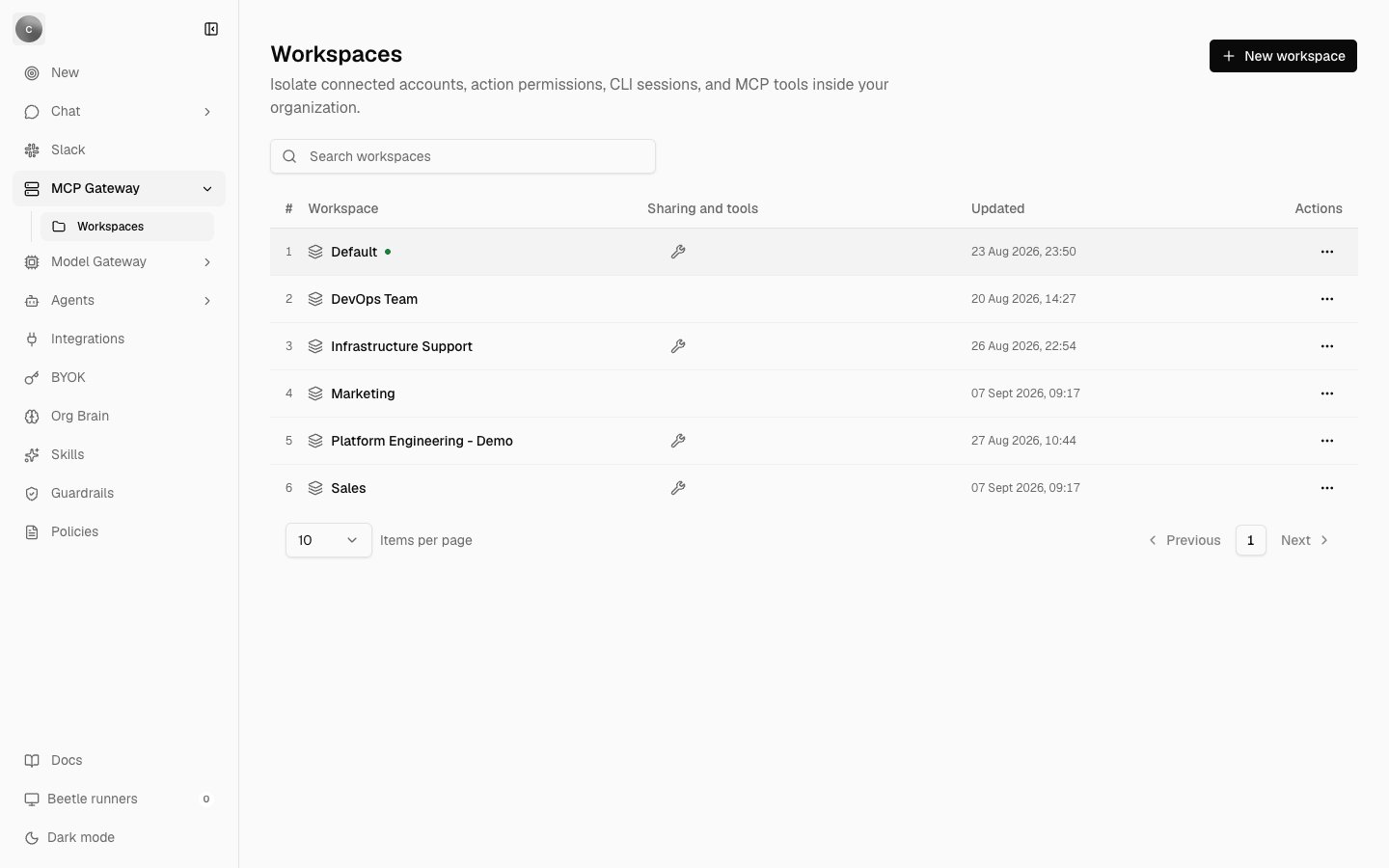
The Workspaces page under MCP Gateway. Each row is an authorization boundary with its own connections; the green dot marks the active workspace — Default here — and a wrench under Sharing and tools marks a workspace that has at least one connected app.
How a tool call travels
The bridge relays each JSON-RPC line to the gateway with your bearer token. On every call the gateway re-checks the token’s scope and your membership of its workspace, looks up the connection and its allowlist, validates the arguments, and forwards the request through the Nango proxy, which adds the provider credential server-side. A write runs only when the token carriesconnect:write and an owner or admin has enabled that operation for that connection; there is no per-action approval prompt in this release. Unknown and disabled tools share one answer, integration action not found or disabled, so a client cannot probe for what it is not allowed to see.
Tool names are opaque aliases of the form receipt_<provider>_<connection>_<tool>_<20 hex characters> — copy them from the listing, never construct one. Connectors that expose the provider’s own MCP server publish nothing through the aggregate endpoint, so an upstream tool added later cannot silently become callable across your organization.
Which clients can attach
Every config the CLI writes is checked before it is saved: one containing the session token, or anything that looks like credential material, is refused.
What is stored, and what is recorded
- Connections. For an app connected through the browser, Receipt stores an encrypted reference — organization, workspace, provider and name mapped to the provider connection — not the credential. The two exceptions are explicit imports: an AWS
credential_processbundle or a GitHub token you import through the CLI, encrypted in the same table. Browsers receive only a connection’s id, organization, workspace, provider, name, kind, status, expiry and timestamps. - Permissions. The per-connection allowlist and the GitHub repository selection live on the connection’s metadata in Nango, never in a client config.
- Your CLI session. A 12-hour bearer token, bound to one workspace, stored in plaintext on your machine and readable only by you. It cannot be revoked before it expires, so treat it like a password — see the security model.
- Receipts. Each
POST /connect/callwrites atool.calledevent and, on success, atool.observedevent into that workspace’s receipt stream, with the recorded output truncated to 2,000 characters.