

SKILL.md file each, that your organization publishes for agents to follow during background runs. From the chat composer you can do two things with them: pick one so the run you are about to start knows which instructions you mean, and ask Receipt to draft a brand-new skill and save it, without opening the Skills page. Uploading, versioning, enabling and deleting skills is covered in Skills; the file format is in Writing a skill.
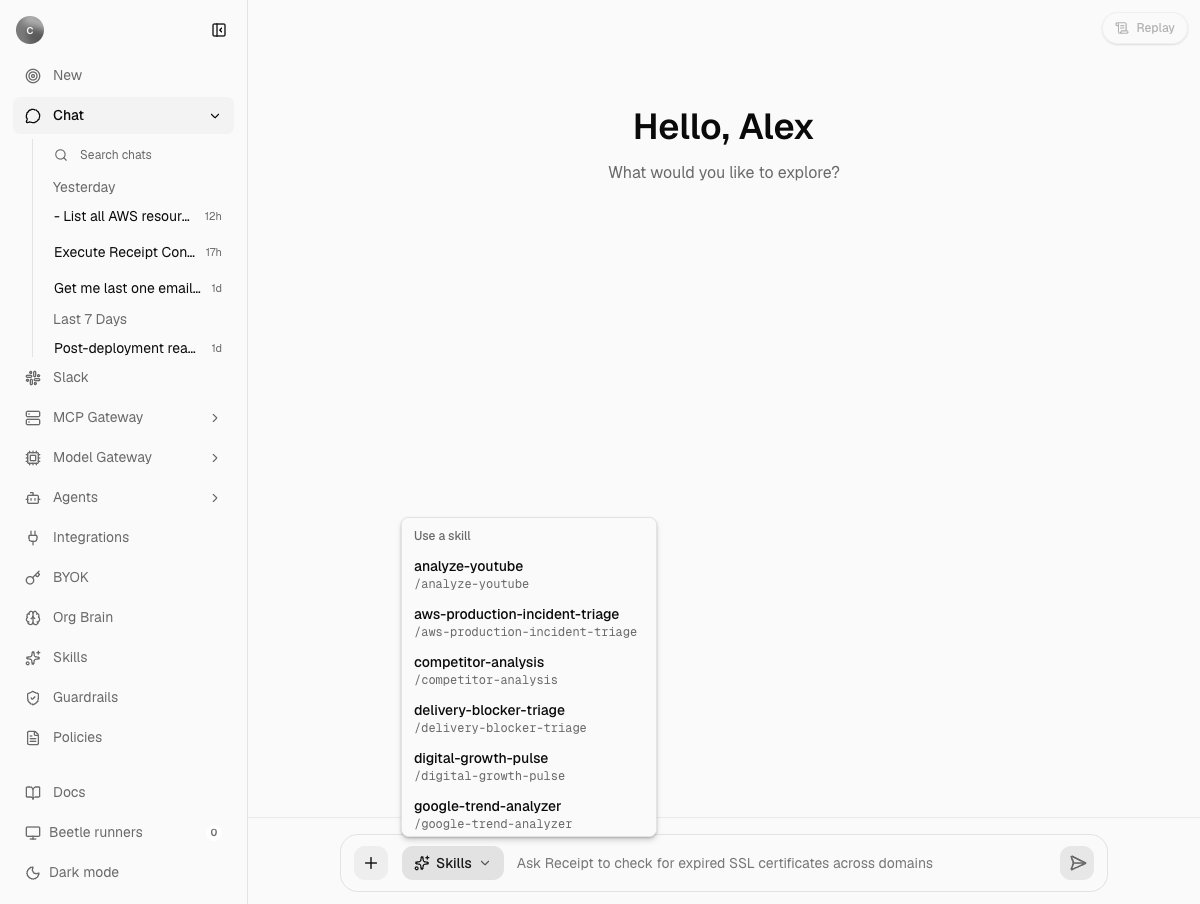
The Skills chip open on a new chat. Under Use a skill, six enabled skills are listed by name with their /slug beneath, which is the most this menu shows. The panel scrolls, so the Create skill and Manage skills items sit below the visible rows. The chip is on the composer toolbar, beside the + button.
Use a skill
The Skills chip sits on the composer toolbar, to the right of+. Open it and the panel lists your organization’s enabled skills under Use a skill. Each entry shows the skill’s name with its /slug underneath; hovering an entry shows its description.
1
Type what you want done
Write the request as you normally would. A skill does not replace the request; it tells the run how to go about it.
2
Open Skills and pick one
Picking a skill appends its slug to the end of your draft.
Check the prod account for failing load balancers becomes Check the prod account for failing load balancers /aws-production-incident-triage . Nothing you typed is replaced, and exactly one space is kept between your text and the slug. You can equally pick the skill first and type after it.3
Send
The message is routed like any other turn. If it needs work in your connected systems, it becomes a background run, and that run receives your message with the slug in it.
- Up to six skills, sorted by name. When the organization has more, a line reading
{n} more on the Skills pageopens the full list. The composer menu is for picking quickly, not browsing; with a long list, typing the slug is faster. - Only enabled skills. Disable a skill on the Skills page and it leaves the menu; an archived skill never appears. When none qualify, the panel says
No enabled skills yet.and offers Create skill and Manage skills underneath. - Every member can pick. The picker works for any member of the organization, not only owners and admins. Managing skills stays an admin job.
What the slug actually does
The slug is plain text. Receipt has no slash-command parser: it does not strip, resolve or validate
/slug before sending your message. It stays in the message exactly as typed, and typing it by hand has the same effect as picking it from the menu.- Routing is unchanged. The router sees the slug as ordinary text in your request and still decides between a direct answer and a background run from what you asked. Its own instructions say that asking an agent to use or select a skill is not a request to author one. See How it works.
- Skills apply to background runs. A direct answer loads no skills at all. A background run gets the whole enabled catalog mounted read-only and chooses from it itself, so naming a slug is a strong hint about which entry is relevant, not a guarantee. How it works describes the mount.
- Nothing records which skill was read. Receipts show that a run started and what it did; there is no receipt for loading a skill. The catalog is written into the run’s workspace and its registry hash is folded into the packet’s projection hash, so the set of skills that was available can be established; which of them the agent read cannot.
Create a skill from chat
In the web app you can ask Receipt to write a new skill for you. The router classifies what you meant, so there is no button or command to press; it reads the intent of your message.
Draft first, then save. A draft reply is headed
## Organization skill draft, followed by **Not saved.** No organization skill changed. and the complete SKILL.md in a fenced block. Read it, ask for changes, and when it looks right say so: if the latest reply contains a valid draft, “save it” persists exactly that file, byte for byte, without generating it again. Asking to save with no reviewed draft in the conversation generates and saves in one step.
A successful save replies:
What can stop a save
Every refusal replies under the heading## Organization skill not saved with the reason and the sentence No skill changed., and the turn is recorded as failed.
The generator is held to the same rules as an upload, plus two of its own: the frontmatter must contain exactly
name and description, and name must already be in lowercase-hyphen form, because it becomes the slug. A hand-written upload may use any display name and gets a derived slug; a chat-authored skill may not. The whole file is capped at 256 KB either way.
What chat cannot do with skills
- Change an existing skill. Requests to update, enable, disable or archive a skill are routed as background delivery work rather than skill authoring, and no background task changes skills, so the request runs as an ordinary objective and the skill is left as it was. Use the Skills page.
- Author more than one file. Chat produces a single
SKILL.md. Supporting files are not generated. - Author from Slack or Teams. Drafting and saving are web-only. A Slack or Teams message that asks for a new skill is routed to a background run instead; see Slack and Teams.
If the router’s decision cannot be used, Receipt asks it once more and then stops the turn with
Receipt couldn't determine the access needed for this request. Please retry; no task was started., shown inside a Beetle stopped before completing this response. banner (Beetle is the interface’s name for the assistant). Nothing is saved and no run starts; send the message again. Other failure text is listed in Errors and limits.Create skill and Manage skills shortcuts
Below the skill list, the chip offers two ways into the Skills page, and there are two more elsewhere in chat:
The Skills page describes itself as “Add organization instructions that agents can use in Factory and computer runs. Enabled skills are available to new runs.” It is owner and admin only: a member who follows any of these shortcuts is redirected to the app root, with no access-denied screen, because the organization settings area as a whole is gated. Using skills from the chip is not affected.