

The vocabulary
Objective
The top unit of work: a durable, receipt-backed goal. Everything Receipt does for it lands on one receipt stream, which is what Replay reads back. Ids look likeobjective_moc07bs6_ovbmts, and every run has a durable address, /chat?objective=<id>, that reopens its thread.
An objective carries a mode — investigation or delivery, below — and a severity from 1 to 5, which sets how much reasoning effort the worker spends. The Tasks page maps Priority onto severity: P1 is 5, P2 is 4, P3 is 3, P4 is 2.
Task
A focused piece of the objective, and a node in a graph: it can depend on other tasks and becomes ready only when they are done. Receipt’s planner, the objective supervisor, produces the graph and extends it as evidence comes in. A task moves throughpending, ready, running, reviewing, approved, integrated, blocked and superseded.
Candidate
One attempt at a task. If an attempt is reviewed and sent back, the next is a new candidate; a task gets at most 4 by default. Candidate statuses areplanned, running, awaiting_review, changes_requested, approved, integrated, rejected and conflicted.
Job
The queued unit of work behind a task, a planning decision, a monitor pass or a cancel. Jobs are what the interface quotes when it hands work off: chat showsBeetle queued job <jobId>. A job is queued, leased, running, completed, failed or canceled. See jobs and durable execution.
Check
A shell command run against the integrated work before it can be promoted — a build or a test suite. Checks run inside the same disposable computer as the work, not on the Receipt server. Investigations run none, because they change nothing. A Tasks-page task runsbun run check:full.
Evidence
What a task has learned so far. Each task carries an evidence status that only ever rises —empty, partial, sufficient, final — and the worker writes an evidence bundle the controller collects. An investigation’s findings each carry a confidence of confirmed, inferred or uncertain, and the result is answered, partial or blocked. A delivery result records an outcome — approved, changes_requested, blocked or partial — plus what changed, the proof, and any remaining work: exactly what the promotion gate reads.
Promotion
The last step of a delivery objective: the approved, checked work is merged into the source branch. First the promotion gate runs, refusing with one of six fixed messages when something is missing — a missing planning receipt, a task still blocked, no integrated task that satisfied the objective, a task without its completion contract or its proof, or a task that still reports remaining work. Delivery objectives promote on their own once the gate passes; investigations skip it, because there is nothing to merge. Factory engine has the exact wording.Investigation or delivery
Every objective is one of two kinds, and the kind decides how much machinery it goes through.
In chat, the router picks the mode from what you asked: read-only evidence becomes an investigation, while “creates, updates, deletes, external artifacts, code/configuration edits, deployments, and pull requests” become delivery. A generated file is an artifact even when the data behind it is read-only, so “count the open tickets and give me a PDF” is delivery. A decision that arrives without a usable mode falls back to delivery, so unknown work takes the stricter path. Tasks created from the Tasks page are always delivery.
“The repo execution slot” is the developer CLI board’s vocabulary, and it is singular there, but the runtime admits several delivery objectives at once — 20 per repository by default, a deployment setting. Only delivery objectives take a slot.
Statuses you will see
An objective’s status is one of twelve values. Three are final —completed, failed and canceled; blocked stops without being final.
Alongside the status the runtime reports a coarser display state —
Draft, Queued, Running, Awaiting Review, Stalled, Blocked, Completed, Archived, Failed, Canceled — and a finer phase, each with a fixed one-line summary. Those summaries are the lines the chat progress panel and the developer CLI print. Five of the ones you are most likely to read:
The Tasks page
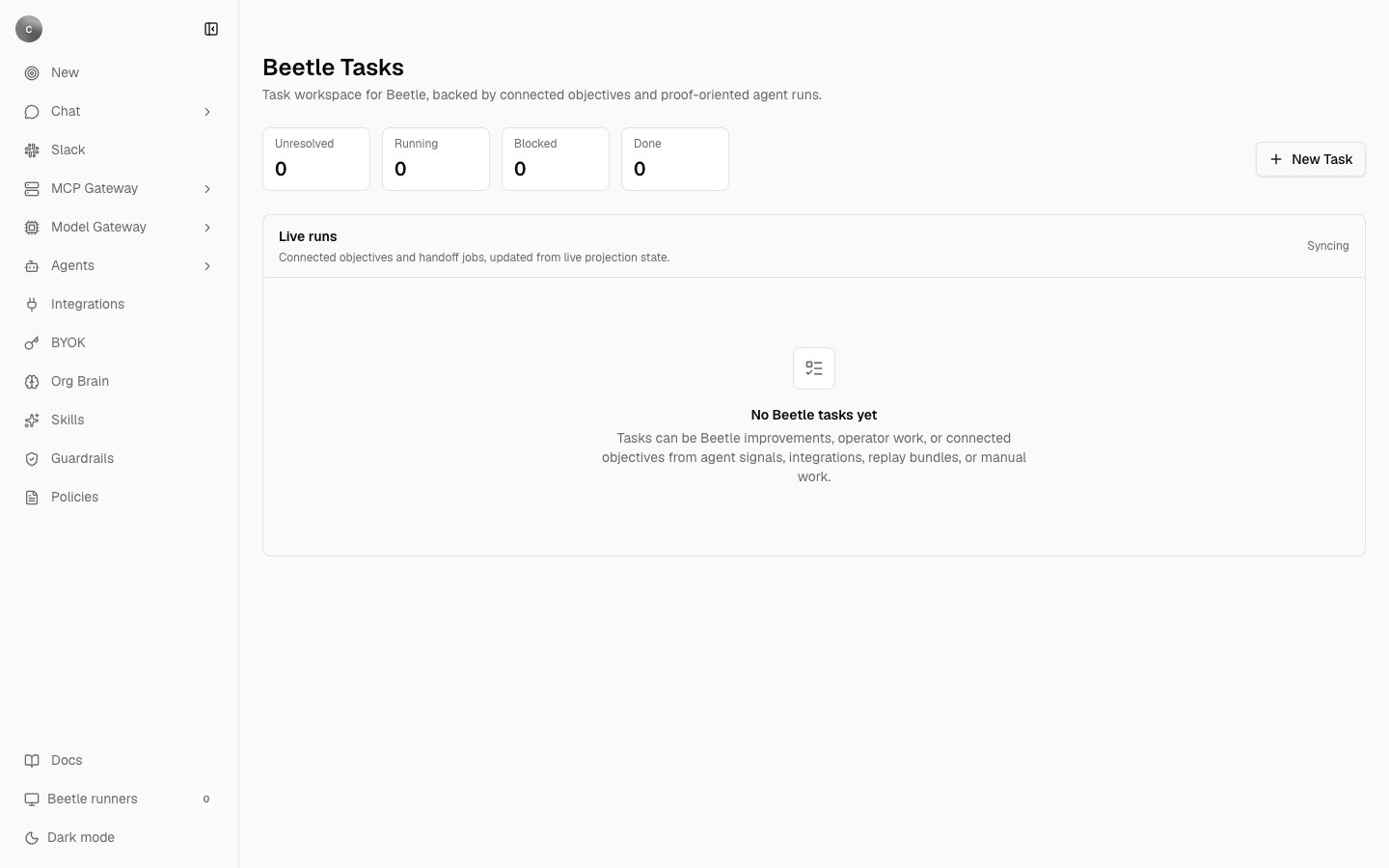
The Tasks page with nothing to show yet. The counters read the stages of the rows that appear under Live runs, which is showing Syncing while the projection loads, and New Task opens the composer. Notice that the sidebar has no Tasks entry; you reach this page by typing its URL.
/tasks is where you start an objective yourself and watch the ones started there. It lists only objectives created on this page, plus Receipt’s own automated fix-up work; a run started from chat or Slack does not appear here — open that one from its thread. Monitoring your runs tours the page; below is what the labels mean.
The counters read the same stages the rows do: Unresolved is everything not yet done, failed or archived; Running covers running and reviewing objectives. A row’s stage comes from the objective’s live state, first matching rule winning: archived, completed, failed or canceled, blocked, a review integration status, any active task or the executing status, a queued slot, otherwise New. A recorded blocker counts even when the status has not caught up, so an objective with tasks still running can read Blocked.
The New task panel
New Task opens a composer for starting an objective yourself. Monitoring your runs walks it field by field and quotes the messages it returns; what matters here is what it produces. You pick one of two lanes — Improvement check (“Investigate a Receipt signal, reproduce it, and return a scoped fix with proof.”) or Add/improve integration (“Build the checked-in connector catalog path, Nango mapping, tests, and PR-ready change.”) — then describe the work, its priority and scope, and what must be true when it is done. Both lanes are written for work on Receipt itself and its connector catalog; the Scope placeholder isReceiptFactory, and Priority becomes the objective’s severity.
Whatever lane you choose, the panel produces a delivery objective: it takes a repository execution slot, runs bun run check:full in the computer, and passes the promotion gate before anything merges.
Save draft stores the draft in your browser, not in Receipt: one draft per browser, not shared with your organization, and no objective is created.
When an objective needs attention
A run can stop without finishing or failing. Its status becomesblocked: the plan cannot go further until something outside the run changes, so Receipt waits instead of retrying. Blocked is deliberately not final — the receipts are intact and the objective can be unblocked or redirected — so every surface gives it its own place.
- In chat, the progress headline turns red, screen readers hear it prefixed Needs attention:, and the message ends with a line such as
Next: Review the blocking receipt and react or cancel the objective.Background runs walks through that message. - On the Tasks page, the row reads Blocked, its summary is
Beetle needs intervention before it can continue., and the blocker is printed in red under the title. The Blocked counter tells you if anything is waiting on you. - On the developer CLI’s board, it sits in the Needs Attention section — “Blocked or conflicted objectives that need review.” — alongside Active, Queued, Completed and Archived. See the in-repo Factory CLI.
Limits that shape an objective
- By default an objective runs at most 5 tasks at once, dispatches at most 50 task runs, allows 4 attempts per task, and has a 24-hour wall-clock budget.
- Computers are shared: one is active per organization by default, so a second objective waits at Waiting for computer until the first releases it.
- Delivery objectives per repository are capped by the slot count, 20 by default.
- Write operations on a connected app must be enabled per connection first. An objective that needs one it lacks stops rather than asking you mid-run; see tools and permissions.