> ## Documentation Index
> Fetch the complete documentation index at: https://docs.kentron.ai/llms.txt
> Use this file to discover all available pages before exploring further.
# Your first chat
> Learn the composer as it actually behaves, including the Skills chip, the + menu, and which controls do nothing on a turn.
Open **Chat**, type what you want in plain language, and press send. Receipt either answers you directly in the thread or, when the request needs evidence from a connected system, starts a background run and reports back when it is done. This page walks the composer control by control, so you know what each one does before you rely on it.
You need a Kentron account and an active organization — [create one](/core/your-account); sign-up on the hosted app is self-service.
**Two composer controls do not change what Receipt does in this release.** The checkboxes in the **Tools** group of the `+` menu — Web Search and Code Interpreter included — are recorded with your thread but never read when a turn runs: direct answers are sent with no tools attached, and background runs do not consult them either. And **Study Mode** pins `openai/gpt-oss-120b`, a model this release cannot reach: the catalog routes it through Azure and the shared AI gateway only, while Receipt executes OpenAI and Anthropic routes. A turn sent in Study Mode therefore ends in an error instead of an answer. Everything else on this page works as described.
## Starting a chat
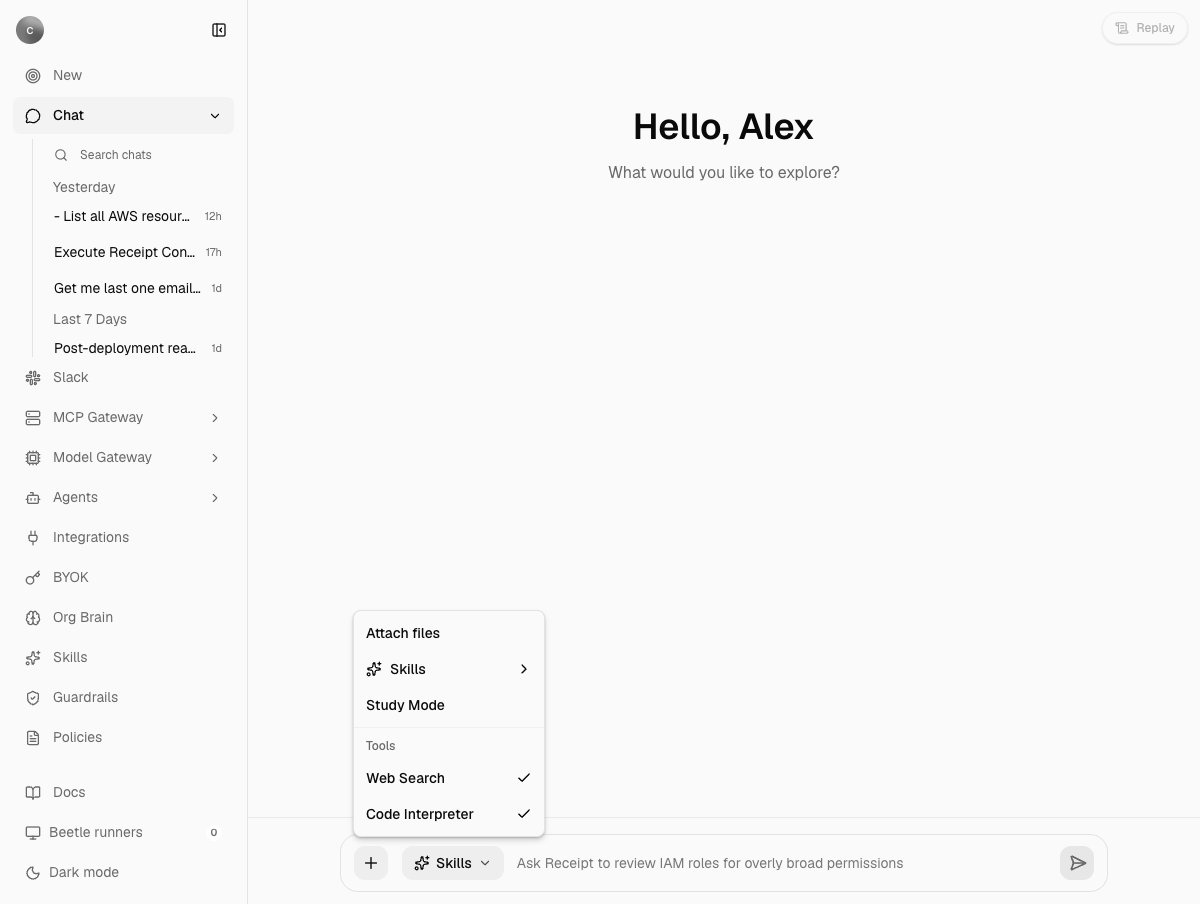
A new chat opens on an empty state: `Hello, ` and `What would you like to explore?` The message box's placeholder cycles through 25 example goals, a new one every 3.2 seconds, each starting `Ask Receipt to …` — for instance `Ask Receipt to review IAM roles for overly broad permissions` or `Ask Receipt to check for expired SSL certificates across domains`. They are examples of the kind of request Receipt is built for, not commands; type your own goal in your own words. Once you're inside a thread, the placeholder becomes `Ask anything`.
When you send, Receipt first decides what kind of turn this is. A question it can answer from the conversation gets a streamed reply in the thread. A request that needs current data from your connected systems, a file, code, or anything outside the chat becomes a [background run](/co-worker/background-runs). A request to write a new organization skill gets a draft you can review. While that decision is being made, the thread shows a status line above the reply — `Sending your message to Beetle...` first, then whatever the run reports ([Beetle](/introduction) is the interface's name for the assistant). The three routes are described in [What the AI Co-Worker does](/co-worker/overview), and the pipeline behind them in [How it works](/co-worker/how-it-works).
## Sending a message
The submit button changes label as your message moves through its lifecycle: **Send message** while idle, **Sending...** once you've submitted, **Stop generation** while the response streams, and **Error** if something goes wrong. While a response is streaming, the same button doubles as a stop control.
Sending is blocked while a file attachment is still uploading and while the thread has reached its context limit (see [Reading the context meter](#reading-the-context-meter) below).
## The `+` menu
Next to the message box, the `+` menu opens:
* **Attach files** — attach up to ten files per message. At the limit, the label itself changes to **Attach files (max reached)**. Accepted types and size limits are on [Files and attachments](/co-worker/files-and-attachments).
* **Skills** — a submenu with one item, **Create skill**, which opens the organization's Skills page on its list, not on the upload picker the chip's identically named item opens. It is a shortcut for administrators; picking a skill to use is the job of the Skills chip described below.
* **Study Mode** — the only mode Receipt ships today. It pins the thread to one fixed study model, injects a study system prompt, and disables all provider-native tools for that thread; while it is on, the Tools group disappears from this menu. If your organization enforces a mode, the checkbox is disabled and its tooltip reads `Study Mode is enforced by your organization`. See the callout at the top of this page before you turn it on.
* **Max** — appears only when the active model has a distinct maximum context window to switch into. If the model doesn't have one, you won't see this control at all.
* **Tools** — a checkbox group listing the provider tools available to the active model, hidden while Study Mode is on.
Checking a tool's box does not mean the model will use it on this turn. Direct answers are sent with no tools attached at all, and a background run decides what to call from the request itself. Real tool work happens only inside a background run, against the connections your organization has enabled. This is the single most common misunderstanding about the composer.
## The Skills chip
Beside `+` sits a **Skills** chip. It lists the organization skills an owner or admin has enabled — versioned instruction files a background run can follow — and picking one appends its `/slug` to whatever you have already typed. The slug is ordinary text: Receipt has no slash-command parser, so the router and any background run read it like the rest of your prompt. [Using skills in chat](/co-worker/skills-in-chat) covers the menu, what a run does with the slug, and how to have Receipt draft a new skill from the conversation; the files themselves are described under [Skills](/catalog/skills).
## What you can't change here
The model picker and the reasoning-effort picker are not currently mounted in the composer. There's nothing to click for either one — a new chat opens on the default model, `openai/gpt-5.6-luna` unless your organization's policy rules it out, and a thread then keeps the model recorded with it. The allowlist that default is drawn from holds OpenAI-routed models only. Which models an organization can use, and how an organization supplies its own provider key, is covered in [Models and providers](/llm-gateway/models-and-providers).
## Reading the context meter
Once you're inside a thread and a model is resolved, a **Context** control appears showing **Input**, **Output**, **Reasoning**, **Cache read**, and **Cache write** from the most recent assistant reply on the branch you're on. A **Total cost** row sums the branch, but appears only when your organization is using its own provider key, or the operator has turned cost display on for everyone — otherwise that row is simply absent.
When the branch reaches the model's limit, the composer stops accepting new messages and shows one of two banners:
* `This conversation has reached the standard context limit. Switch to Max to continue with the larger window.` — when the model has a larger window and you are still on the standard one. Turn on **Max** in the `+` menu to continue.
* `This conversation has reached its current context limit. Start a new chat to continue.` — when there is no larger window to switch to.
## Titles and long pastes
A thread is called `New Chat` until Receipt generates a short title from your first message. If you rename a thread yourself, that permanently turns off auto-titling for it — Receipt won't overwrite your title later.
Pasting 2,000 characters or more of plain text turns the paste into a text attachment instead of inline text, as long as the embedding feature is on for your deployment. The attachment is named `pasted-text--
 Next to the message box, the `+` menu opens:
* **Attach files** — attach up to ten files per message. At the limit, the label itself changes to **Attach files (max reached)**. Accepted types and size limits are on [Files and attachments](/co-worker/files-and-attachments).
* **Skills** — a submenu with one item, **Create skill**, which opens the organization's Skills page on its list, not on the upload picker the chip's identically named item opens. It is a shortcut for administrators; picking a skill to use is the job of the Skills chip described below.
* **Study Mode** — the only mode Receipt ships today. It pins the thread to one fixed study model, injects a study system prompt, and disables all provider-native tools for that thread; while it is on, the Tools group disappears from this menu. If your organization enforces a mode, the checkbox is disabled and its tooltip reads `Study Mode is enforced by your organization`. See the callout at the top of this page before you turn it on.
* **Max** — appears only when the active model has a distinct maximum context window to switch into. If the model doesn't have one, you won't see this control at all.
* **Tools** — a checkbox group listing the provider tools available to the active model, hidden while Study Mode is on.
Checking a tool's box does not mean the model will use it on this turn. Direct answers are sent with no tools attached at all, and a background run decides what to call from the request itself. Real tool work happens only inside a background run, against the connections your organization has enabled. This is the single most common misunderstanding about the composer.
## The Skills chip
Beside `+` sits a **Skills** chip. It lists the organization skills an owner or admin has enabled — versioned instruction files a background run can follow — and picking one appends its `/slug` to whatever you have already typed. The slug is ordinary text: Receipt has no slash-command parser, so the router and any background run read it like the rest of your prompt. [Using skills in chat](/co-worker/skills-in-chat) covers the menu, what a run does with the slug, and how to have Receipt draft a new skill from the conversation; the files themselves are described under [Skills](/catalog/skills).
## What you can't change here
The model picker and the reasoning-effort picker are not currently mounted in the composer. There's nothing to click for either one — a new chat opens on the default model, `openai/gpt-5.6-luna` unless your organization's policy rules it out, and a thread then keeps the model recorded with it. The allowlist that default is drawn from holds OpenAI-routed models only. Which models an organization can use, and how an organization supplies its own provider key, is covered in [Models and providers](/llm-gateway/models-and-providers).
## Reading the context meter
Once you're inside a thread and a model is resolved, a **Context** control appears showing **Input**, **Output**, **Reasoning**, **Cache read**, and **Cache write** from the most recent assistant reply on the branch you're on. A **Total cost** row sums the branch, but appears only when your organization is using its own provider key, or the operator has turned cost display on for everyone — otherwise that row is simply absent.
When the branch reaches the model's limit, the composer stops accepting new messages and shows one of two banners:
* `This conversation has reached the standard context limit. Switch to Max to continue with the larger window.` — when the model has a larger window and you are still on the standard one. Turn on **Max** in the `+` menu to continue.
* `This conversation has reached its current context limit. Start a new chat to continue.` — when there is no larger window to switch to.
## Titles and long pastes
A thread is called `New Chat` until Receipt generates a short title from your first message. If you rename a thread yourself, that permanently turns off auto-titling for it — Receipt won't overwrite your title later.
Pasting 2,000 characters or more of plain text turns the paste into a text attachment instead of inline text, as long as the embedding feature is on for your deployment. The attachment is named `pasted-text-
Next to the message box, the `+` menu opens:
* **Attach files** — attach up to ten files per message. At the limit, the label itself changes to **Attach files (max reached)**. Accepted types and size limits are on [Files and attachments](/co-worker/files-and-attachments).
* **Skills** — a submenu with one item, **Create skill**, which opens the organization's Skills page on its list, not on the upload picker the chip's identically named item opens. It is a shortcut for administrators; picking a skill to use is the job of the Skills chip described below.
* **Study Mode** — the only mode Receipt ships today. It pins the thread to one fixed study model, injects a study system prompt, and disables all provider-native tools for that thread; while it is on, the Tools group disappears from this menu. If your organization enforces a mode, the checkbox is disabled and its tooltip reads `Study Mode is enforced by your organization`. See the callout at the top of this page before you turn it on.
* **Max** — appears only when the active model has a distinct maximum context window to switch into. If the model doesn't have one, you won't see this control at all.
* **Tools** — a checkbox group listing the provider tools available to the active model, hidden while Study Mode is on.
Checking a tool's box does not mean the model will use it on this turn. Direct answers are sent with no tools attached at all, and a background run decides what to call from the request itself. Real tool work happens only inside a background run, against the connections your organization has enabled. This is the single most common misunderstanding about the composer.
## The Skills chip
Beside `+` sits a **Skills** chip. It lists the organization skills an owner or admin has enabled — versioned instruction files a background run can follow — and picking one appends its `/slug` to whatever you have already typed. The slug is ordinary text: Receipt has no slash-command parser, so the router and any background run read it like the rest of your prompt. [Using skills in chat](/co-worker/skills-in-chat) covers the menu, what a run does with the slug, and how to have Receipt draft a new skill from the conversation; the files themselves are described under [Skills](/catalog/skills).
## What you can't change here
The model picker and the reasoning-effort picker are not currently mounted in the composer. There's nothing to click for either one — a new chat opens on the default model, `openai/gpt-5.6-luna` unless your organization's policy rules it out, and a thread then keeps the model recorded with it. The allowlist that default is drawn from holds OpenAI-routed models only. Which models an organization can use, and how an organization supplies its own provider key, is covered in [Models and providers](/llm-gateway/models-and-providers).
## Reading the context meter
Once you're inside a thread and a model is resolved, a **Context** control appears showing **Input**, **Output**, **Reasoning**, **Cache read**, and **Cache write** from the most recent assistant reply on the branch you're on. A **Total cost** row sums the branch, but appears only when your organization is using its own provider key, or the operator has turned cost display on for everyone — otherwise that row is simply absent.
When the branch reaches the model's limit, the composer stops accepting new messages and shows one of two banners:
* `This conversation has reached the standard context limit. Switch to Max to continue with the larger window.` — when the model has a larger window and you are still on the standard one. Turn on **Max** in the `+` menu to continue.
* `This conversation has reached its current context limit. Start a new chat to continue.` — when there is no larger window to switch to.
## Titles and long pastes
A thread is called `New Chat` until Receipt generates a short title from your first message. If you rename a thread yourself, that permanently turns off auto-titling for it — Receipt won't overwrite your title later.
Pasting 2,000 characters or more of plain text turns the paste into a text attachment instead of inline text, as long as the embedding feature is on for your deployment. The attachment is named `pasted-text-