> ## Documentation Index
> Fetch the complete documentation index at: https://docs.kentron.ai/llms.txt
> Use this file to discover all available pages before exploring further.
# Replay a run
> Open Agent replay to read what a run concluded, every command and app call it made, and the receipts behind each step.
Every run leaves a trail you can inspect. Replay shows you the recorded outcome, an optional AI recap, the list of commands and connected-app calls in the order they happened, and the full conversation with every receipt behind it. You can filter the trail by activity or by receipt type, and print the whole thing to PDF.
## Opening Replay
The **Replay** pill sits top-right of the chat page. It stays disabled until the current chat has a thread or a background run to inspect. The Tasks page at `/tasks` has a **Receipts** button on each run that opens the same dialog for that objective; see [Monitoring your runs](/co-worker/monitoring).
The dialog's eyebrow reads **Agent replay**. Below the title you see the objective id and, when you opened the dialog from a chat, the run's duration and when it started; then a row of status pills: the run's status (for example **Completed**), `{n} meaningful actions`, `{n} connected apps` when any were used, `{n} receipts`, and **Live**. Hovering **Live** shows `Updated {time}`, meaning when the view last loaded, or `Waiting for receipts` before the first load finishes. The dialog subscribes to the receipt event stream while it is open, but it does not repaint on its own in this release: use the refresh button (**Refresh agent replay**) to pull in receipts that landed since the view loaded.
Before a run exists the title reads **Waiting for a run**.
## The three tabs
A tab strip labelled **Replay views** offers **Summary**, **Transcript** and **Work**. The dialog opens on Transcript.
### Summary
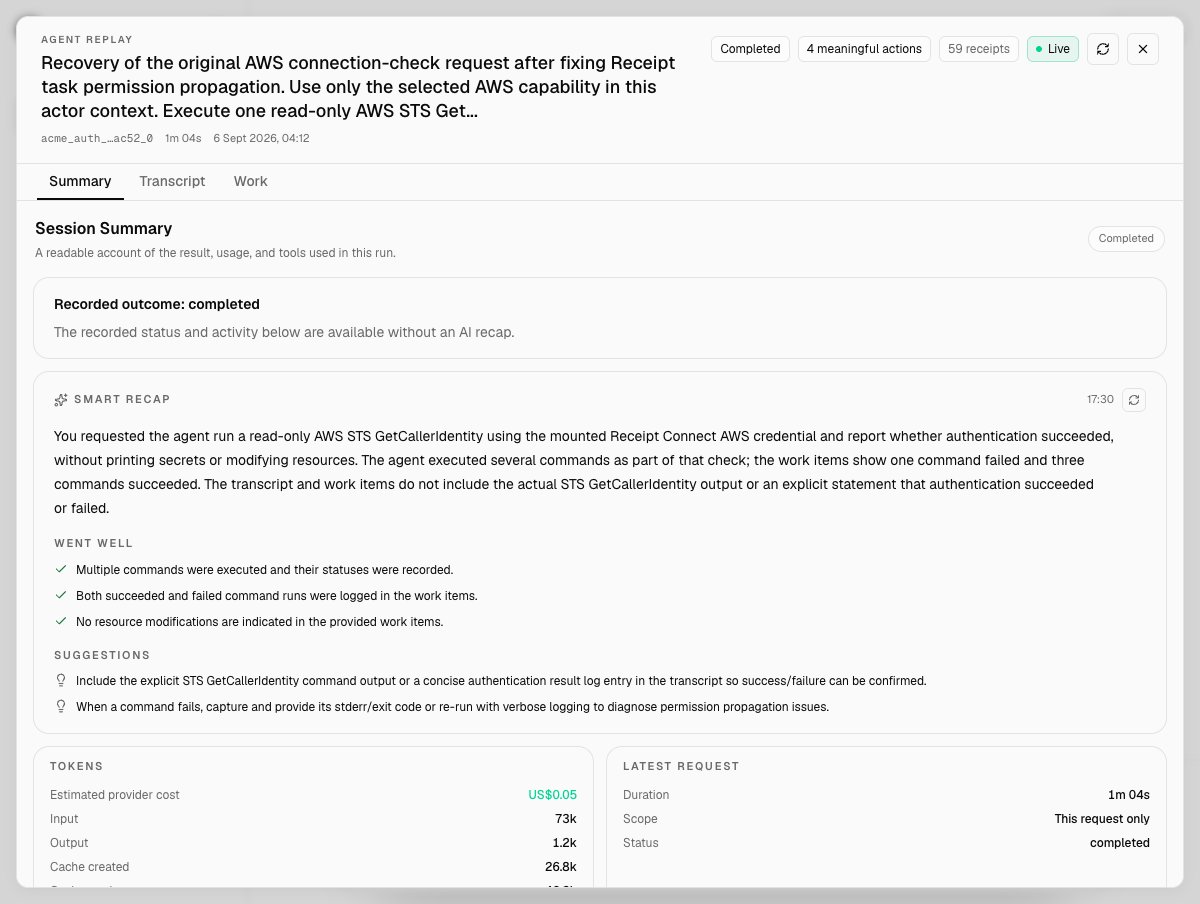 The tab is headed **Session Summary**, with the line `A readable account of the result, usage, and tools used in this run.`
The **Recorded outcome** section comes first, headed `Recorded outcome: {status}`. It shows the last assistant message of the latest run, up to 2,000 characters. When the run left no assistant text it reads `The recorded status and activity below are available without an AI recap.` This section needs no model call; it is always available.
**Smart recap** is an AI-written reading of the same receipts, and it is optional. Opening the Summary tab requests it once per session; while it loads the panel reads `Preparing optional AI recap…`. A finished recap shows a few sentences, a **Went well** list and a **Suggestions** list, the time it was generated, and a **Regenerate summary** button. If it is not ready, the panel offers **Generate summary**, or **Try again** after a failure.
The recap has three states that read differently:
| State | What you see |
| ----------- | ----------------------------------------------------------------------------------------------------------------------------------------------------------------------------------------- |
| Ready | The recap text, **Went well** (up to three items) and **Suggestions** (up to two). |
| Unavailable | A reason and no button: `Connect a OpenAI key in organization settings to generate AI summaries.`, `There is no recorded activity to summarize yet.`, or `This session is not available.` |
| Failed | The reason and a **Try again** button, for example `The model did not return a usable summary.` |
The recap is generated with your organization's own provider key through the [LLM Gateway](/llm-gateway/bring-your-own-key) — an organization owner or admin is the one who saves that key — using `openai/gpt-5-mini` unless `CHAT_RECEIPT_RECAP_MODEL` names another model. Without a key it is unavailable rather than silently replaced by a machine-written blurb. A generated recap is stored and reused on later views until the conversation changes or you regenerate it, so opening Summary again does not cost another model call. Generation is bounded: the client gives up after 25 seconds with `The AI recap took too long. Your recorded outcome remains available. You can try again.`
Below the recap sit the stat cards:
* **Tokens** — **Estimated provider cost**, **Input**, **Output**, **Cache created**, **Cache read**, and **Saved by cache read** when the cache returned tokens. When nothing was recorded, the cost row reads `Not recorded` rather than showing a zero, so you can always tell an untracked cost apart from a genuinely free run. A run with no usage at all reads `Token and cost data were not recorded for this request.`
* **Latest request** — **Duration**, **Scope** (`This request only`) and **Status**.
* **Conversation** — **Messages**, **User prompts**, **Assistant replies** and **Proof events**, the last being the receipt count.
* **Action outcomes** — a bar and counts for **Succeeded**, **Running**, **Warnings** and **Failed**.
* **Work mix** — counts of **Commands**, **Tool calls**, **Connected-app calls** and **Verified outputs**.
### Work
The tab is headed **Session Summary**, with the line `A readable account of the result, usage, and tools used in this run.`
The **Recorded outcome** section comes first, headed `Recorded outcome: {status}`. It shows the last assistant message of the latest run, up to 2,000 characters. When the run left no assistant text it reads `The recorded status and activity below are available without an AI recap.` This section needs no model call; it is always available.
**Smart recap** is an AI-written reading of the same receipts, and it is optional. Opening the Summary tab requests it once per session; while it loads the panel reads `Preparing optional AI recap…`. A finished recap shows a few sentences, a **Went well** list and a **Suggestions** list, the time it was generated, and a **Regenerate summary** button. If it is not ready, the panel offers **Generate summary**, or **Try again** after a failure.
The recap has three states that read differently:
| State | What you see |
| ----------- | ----------------------------------------------------------------------------------------------------------------------------------------------------------------------------------------- |
| Ready | The recap text, **Went well** (up to three items) and **Suggestions** (up to two). |
| Unavailable | A reason and no button: `Connect a OpenAI key in organization settings to generate AI summaries.`, `There is no recorded activity to summarize yet.`, or `This session is not available.` |
| Failed | The reason and a **Try again** button, for example `The model did not return a usable summary.` |
The recap is generated with your organization's own provider key through the [LLM Gateway](/llm-gateway/bring-your-own-key) — an organization owner or admin is the one who saves that key — using `openai/gpt-5-mini` unless `CHAT_RECEIPT_RECAP_MODEL` names another model. Without a key it is unavailable rather than silently replaced by a machine-written blurb. A generated recap is stored and reused on later views until the conversation changes or you regenerate it, so opening Summary again does not cost another model call. Generation is bounded: the client gives up after 25 seconds with `The AI recap took too long. Your recorded outcome remains available. You can try again.`
Below the recap sit the stat cards:
* **Tokens** — **Estimated provider cost**, **Input**, **Output**, **Cache created**, **Cache read**, and **Saved by cache read** when the cache returned tokens. When nothing was recorded, the cost row reads `Not recorded` rather than showing a zero, so you can always tell an untracked cost apart from a genuinely free run. A run with no usage at all reads `Token and cost data were not recorded for this request.`
* **Latest request** — **Duration**, **Scope** (`This request only`) and **Status**.
* **Conversation** — **Messages**, **User prompts**, **Assistant replies** and **Proof events**, the last being the receipt count.
* **Action outcomes** — a bar and counts for **Succeeded**, **Running**, **Warnings** and **Failed**.
* **Work mix** — counts of **Commands**, **Tool calls**, **Connected-app calls** and **Verified outputs**.
### Work
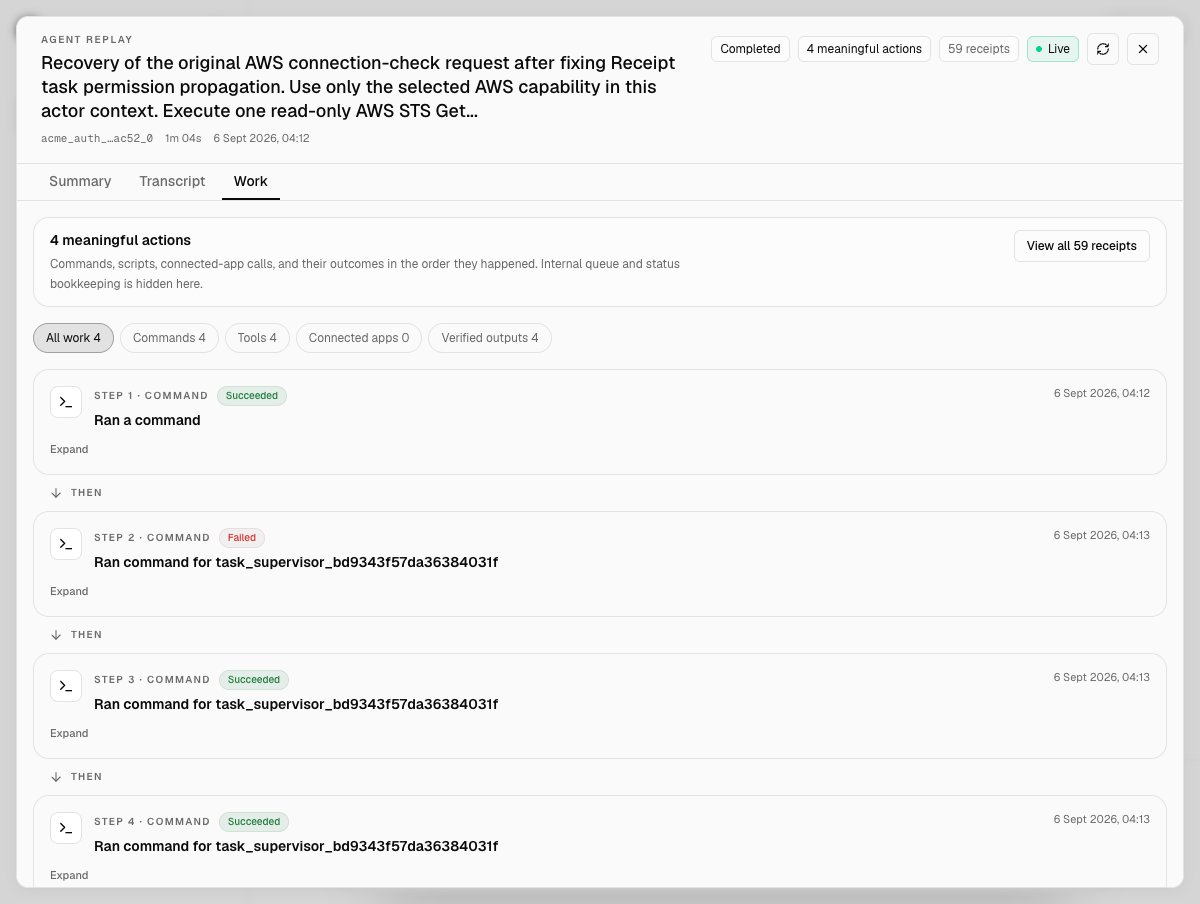 Work is the short list. Its header reads `{n} meaningful actions`, described as `Commands, scripts, connected-app calls, and their outcomes in the order they happened. Internal queue and status bookkeeping is hidden here.` The `View all {n} receipts` button switches to the Transcript tab.
Chips filter the list, each carrying its count: **All work**, **Commands**, **Tools**, **Connected apps** and **Verified outputs**. Choosing **Connected apps** replaces the list with a card per connected app the run used. While the list is being derived the tab reads `Reconstructing work from receipts`.
Each item is a numbered step typed as a **Command**, **Tool**, **Connected app** or **Evidence**, with a status badge of **Succeeded**, **Failed**, **Needs attention**, **Running** or **Observed**, its title — `Ran a command`, or `Ran command for ` when the receipt names the Factory task that ran it, which is what the capture above shows — and the time it started. **Expand** shows the tool that ran, **What ran** with the command itself, an optional **Show inputs** block, **What happened** with the recorded outcome, and the step's `Receipt checkpoint #{n}`. Consecutive steps are joined by a **Then** connector.
### Transcript
Work is the short list. Its header reads `{n} meaningful actions`, described as `Commands, scripts, connected-app calls, and their outcomes in the order they happened. Internal queue and status bookkeeping is hidden here.` The `View all {n} receipts` button switches to the Transcript tab.
Chips filter the list, each carrying its count: **All work**, **Commands**, **Tools**, **Connected apps** and **Verified outputs**. Choosing **Connected apps** replaces the list with a card per connected app the run used. While the list is being derived the tab reads `Reconstructing work from receipts`.
Each item is a numbered step typed as a **Command**, **Tool**, **Connected app** or **Evidence**, with a status badge of **Succeeded**, **Failed**, **Needs attention**, **Running** or **Observed**, its title — `Ran a command`, or `Ran command for ` when the receipt names the Factory task that ran it, which is what the capture above shows — and the time it started. **Expand** shows the tool that ran, **What ran** with the command itself, an optional **Show inputs** block, **What happened** with the recorded outcome, and the step's `Receipt checkpoint #{n}`. Consecutive steps are joined by a **Then** connector.
### Transcript
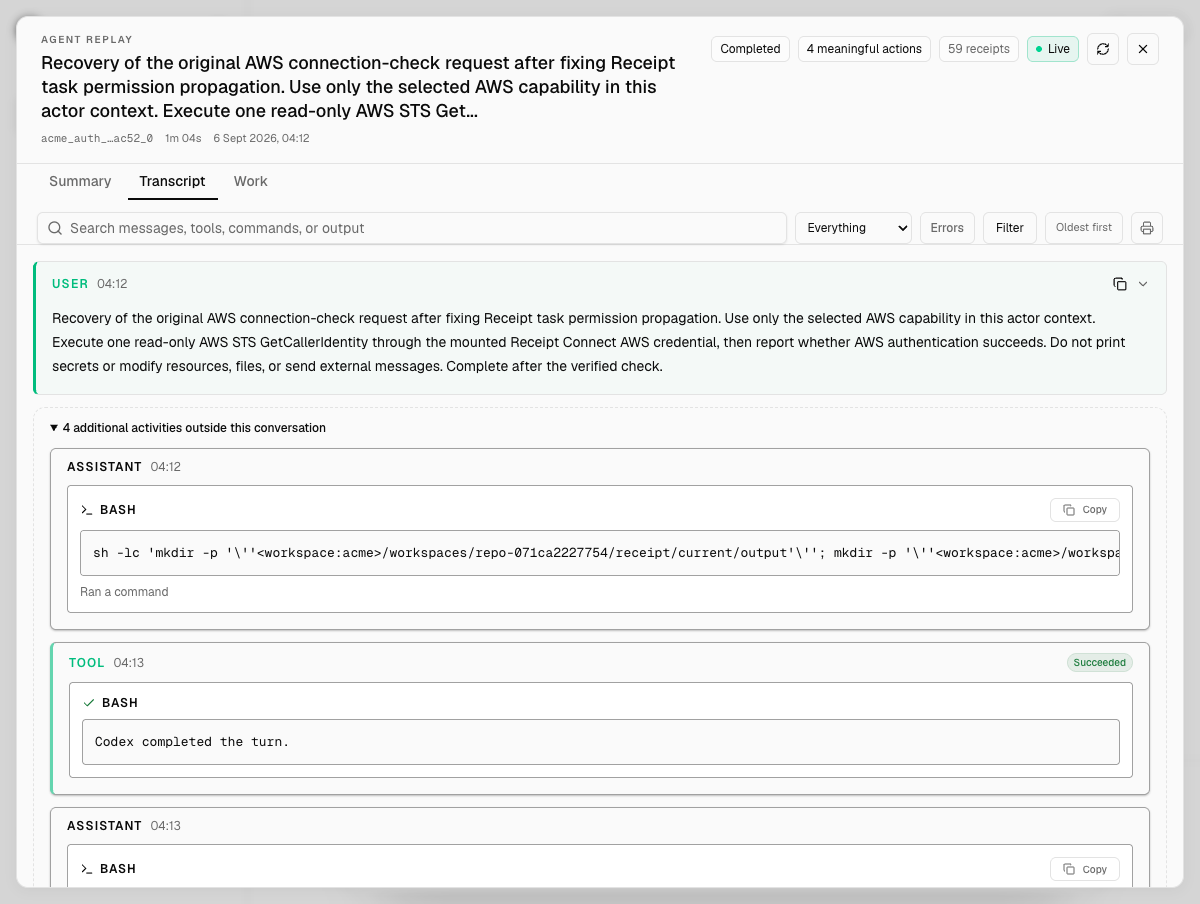 The transcript is rebuilt from the conversation's stored messages: one **USER** or **ASSISTANT** entry per message, in order, each with its time and a copy button. Every work item is attached to the assistant turn whose time window contains it, so a command appears under the reply that ran it. Work that falls outside every assistant turn is not dropped or guessed at; it is grouped under a collapsible `{n} additional activities outside this conversation`. When you open a run from the Tasks page, the transcript starts with the objective's request as the user turn and lists all of its work in that group. A run whose recorded request begins with `objective handoff for` has no request worth showing, so the tab falls back to the receipt log below.
Tool blocks are labelled with the tool that ran (for example **BASH**), show the command and its output, and carry a **Copy** button; a long message offers **Show full message**.
The toolbar filters what you see:
* **Search** — the box reads `Search messages, tools, commands, or output`.
* **Activity** — a select that defaults to **Everything**, with **Problems**, **State changes**, **Evidence**, **Commands**, **Jobs**, **Memory** and **Computer**. Each option keeps receipts whose text mentions a fixed set of words; **Problems**, for example, matches `error`, `failed`, `blocked`, `timeout`, `stale`, `missing`, `invalid` and `denied`, and **Jobs** matches `job`, `queue`, `lease`, `worker` and `control`. The **Errors** button is a shortcut that toggles **Problems**.
* **Filter** — opens a popover with a **Receipt type** select. It starts at **All event types** and lists every receipt type present in the run, alphabetically, with its count, in the form `{type} ({count})`. On a background run you will typically see types such as `objective.created`, `computer.command.started`, `computer.command.stdout.observed`, `computer.command.completed`, `computer.command.failed`, `tool.called`, `tool.observed`, `connector.command.started` and `connector.command.completed`.
* **Oldest first** — a label, not a control: the transcript always runs oldest to newest.
With filters applied the messages stay in place and the activities under them narrow to the receipts that match. A search with no match reads `No transcript messages or activity match “…”.` In the receipt log below, filtering everything out reads `No proof events were found for the selected filters.`
## The receipt log and replaying to a step
When Receipt has no conversation text to rebuild, the Transcript tab shows the receipt log instead: every receipt in the run, oldest first, 200 to a page, with a search box that reads `Search hash or payload` and the same activity, Errors and Filter controls. The tab's live announcement then says **Receipt log** rather than **Transcript**.
Selecting a receipt expands it into an inspector with two views:
* **Overview** — a sentence explaining what the receipt means, then **Status**, **Recorded**, **Agent** and **Source step**. A command receipt also shows **Command the agent ran** and its **Output**.
* **Raw receipt** — the full record as a JSON tree, with a **Copy receipt** button that briefly reads **Copied**.
Under the inspector, **Replay to this step** explains itself: `Rebuild the agent state through global checkpoint #{n}. This is a safe preview and never changes the receipt log.` Pressing it (the button reads `Replaying…` while it works) folds the receipts up to that checkpoint into the run's derived state and shows **Replay preview ready** with `State at Global #{n}`, a list of fields that changed as `before → after`, or `No visible state changed at this step.`, and a line such as `Rebuilt 4 derived views.` It is a dry run: nothing is appended and no projection is modified. Replay needs a background run, so the button is disabled on a chat that only received direct answers. If the preview cannot be built for the selected receipt you see `Replay preview is not available for this receipt.`
Receipts are tamper-evident, SHA-256 hash-chained records; the run's derived views are rebuilt from them, never the other way round. How the chain is stored and replayed is covered in [Receipts and streams](/core/receipts-and-streams).
## Printing
The printer button in the Transcript toolbar is titled **Print all records to PDF**. It opens a print-ready copy of the transcript in a new tab and triggers the browser's print dialog, which is where **Save as PDF** lives. The document carries the run title and metadata, every message and work item, and a final **Activity outside this conversation** section when there is one.
## When receipts are not available
The dialog quotes these messages when it cannot load the trail:
| Message | Meaning |
| --------------------------------------------------------------------------------------------------- | ------------------------------------------------------------------------------------------------------------ |
| `Receipts are not available for this task yet. Try again in a moment.` (or `…for this thread yet…`) | Nothing has been recorded for this run yet, or it is not readable from your organization; try again shortly. |
| `Unable to load receipts for this task.` (or `…for this thread.`) | The load failed; use **Refresh agent replay**. |
## Where to go after a run stops
The commonest reason a run stops early is an app nobody has connected yet, and that is fixed outside chat: [what the MCP Gateway is](/mcp-gateway/overview) explains connections, workspaces and who owns them, and [Connect an app](/mcp-gateway/connect-an-app) walks an owner or admin through connecting the first one.
Next step: [use a skill in chat](/co-worker/skills-in-chat).
The transcript is rebuilt from the conversation's stored messages: one **USER** or **ASSISTANT** entry per message, in order, each with its time and a copy button. Every work item is attached to the assistant turn whose time window contains it, so a command appears under the reply that ran it. Work that falls outside every assistant turn is not dropped or guessed at; it is grouped under a collapsible `{n} additional activities outside this conversation`. When you open a run from the Tasks page, the transcript starts with the objective's request as the user turn and lists all of its work in that group. A run whose recorded request begins with `objective handoff for` has no request worth showing, so the tab falls back to the receipt log below.
Tool blocks are labelled with the tool that ran (for example **BASH**), show the command and its output, and carry a **Copy** button; a long message offers **Show full message**.
The toolbar filters what you see:
* **Search** — the box reads `Search messages, tools, commands, or output`.
* **Activity** — a select that defaults to **Everything**, with **Problems**, **State changes**, **Evidence**, **Commands**, **Jobs**, **Memory** and **Computer**. Each option keeps receipts whose text mentions a fixed set of words; **Problems**, for example, matches `error`, `failed`, `blocked`, `timeout`, `stale`, `missing`, `invalid` and `denied`, and **Jobs** matches `job`, `queue`, `lease`, `worker` and `control`. The **Errors** button is a shortcut that toggles **Problems**.
* **Filter** — opens a popover with a **Receipt type** select. It starts at **All event types** and lists every receipt type present in the run, alphabetically, with its count, in the form `{type} ({count})`. On a background run you will typically see types such as `objective.created`, `computer.command.started`, `computer.command.stdout.observed`, `computer.command.completed`, `computer.command.failed`, `tool.called`, `tool.observed`, `connector.command.started` and `connector.command.completed`.
* **Oldest first** — a label, not a control: the transcript always runs oldest to newest.
With filters applied the messages stay in place and the activities under them narrow to the receipts that match. A search with no match reads `No transcript messages or activity match “…”.` In the receipt log below, filtering everything out reads `No proof events were found for the selected filters.`
## The receipt log and replaying to a step
When Receipt has no conversation text to rebuild, the Transcript tab shows the receipt log instead: every receipt in the run, oldest first, 200 to a page, with a search box that reads `Search hash or payload` and the same activity, Errors and Filter controls. The tab's live announcement then says **Receipt log** rather than **Transcript**.
Selecting a receipt expands it into an inspector with two views:
* **Overview** — a sentence explaining what the receipt means, then **Status**, **Recorded**, **Agent** and **Source step**. A command receipt also shows **Command the agent ran** and its **Output**.
* **Raw receipt** — the full record as a JSON tree, with a **Copy receipt** button that briefly reads **Copied**.
Under the inspector, **Replay to this step** explains itself: `Rebuild the agent state through global checkpoint #{n}. This is a safe preview and never changes the receipt log.` Pressing it (the button reads `Replaying…` while it works) folds the receipts up to that checkpoint into the run's derived state and shows **Replay preview ready** with `State at Global #{n}`, a list of fields that changed as `before → after`, or `No visible state changed at this step.`, and a line such as `Rebuilt 4 derived views.` It is a dry run: nothing is appended and no projection is modified. Replay needs a background run, so the button is disabled on a chat that only received direct answers. If the preview cannot be built for the selected receipt you see `Replay preview is not available for this receipt.`
Receipts are tamper-evident, SHA-256 hash-chained records; the run's derived views are rebuilt from them, never the other way round. How the chain is stored and replayed is covered in [Receipts and streams](/core/receipts-and-streams).
## Printing
The printer button in the Transcript toolbar is titled **Print all records to PDF**. It opens a print-ready copy of the transcript in a new tab and triggers the browser's print dialog, which is where **Save as PDF** lives. The document carries the run title and metadata, every message and work item, and a final **Activity outside this conversation** section when there is one.
## When receipts are not available
The dialog quotes these messages when it cannot load the trail:
| Message | Meaning |
| --------------------------------------------------------------------------------------------------- | ------------------------------------------------------------------------------------------------------------ |
| `Receipts are not available for this task yet. Try again in a moment.` (or `…for this thread yet…`) | Nothing has been recorded for this run yet, or it is not readable from your organization; try again shortly. |
| `Unable to load receipts for this task.` (or `…for this thread.`) | The load failed; use **Refresh agent replay**. |
## Where to go after a run stops
The commonest reason a run stops early is an app nobody has connected yet, and that is fixed outside chat: [what the MCP Gateway is](/mcp-gateway/overview) explains connections, workspaces and who owns them, and [Connect an app](/mcp-gateway/connect-an-app) walks an owner or admin through connecting the first one.
Next step: [use a skill in chat](/co-worker/skills-in-chat).